I wonder, beyond the requisite
“doing well” goal that seems to match every class, how to best quantify what I
want out of this course. Besides performing to the best of my ability, I want
to be challenged. I want my viewpoints to be altered with new knowledge and I
want to be able to take what I learn in this course to further classes and my
classroom in the future. For a relatively abstract idea (democracy), I want it
to become self-evident and for it to be cemented into my mind. Democracy seems
uneven in the classroom and one of my goals is to be able to more readily
observe it.
To that end, I would like to see
democratic activities within the classroom. Since it occurs to me that I have
difficulty, particularly in relation to college classes, relating democracy to
the classroom, examples would be helpful. With the creation of groups, one can
clearly see the power dynamic and how democracy should work. In a group where
everyone does his or her part, the work progresses better than simply the sum
of its parts. In classes where group work assigned has everyone participating
to the best of his or her ability, things turn out wonderfully. I would like to
see that happen again, where everyone pulls his or her own weight and turns an
assignment into an art form.
Yet as I consider this, I also
consider the reading due for this week. It seems as though the book mentioned
the history of schools and democracy within without revealing all the evidence
for why democracy is necessary. Yes,
schools taught students to be patriotic in the past and people who worked to
improve schools thought schools should be used to create better citizens. The
questions linger, however: why? How? How does school transform students into
better citizens? What activities lead this to happen? Why is it schools, among
other venues, that culminate in better citizens as opposed to say, churches or
community events? What is it about a class that better lends itself to
democracy?
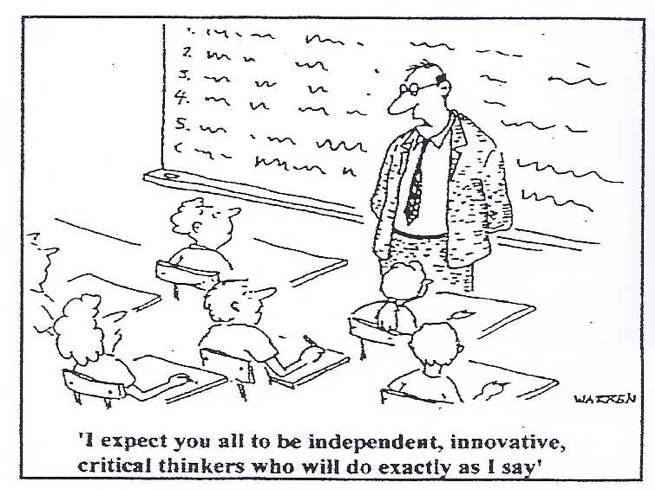
For the most part, it does not
appear as though classrooms always facilitate independent thought. Teachers
‘teach’ to the test and evaluations are at a premium, with tension weighing
heavily upon students and teachers to perform. In school, one does a teacher
has instructed one to do. Yet in a democracy, teachers should listen to their
students and accept feedback. How often does this really happen? Does democracy
still exist within the classroom? If so, where?
(I open the floor for discussion).

No comments:
Post a Comment