Wednesday, September 25, 2013

Democracy in the Classroom

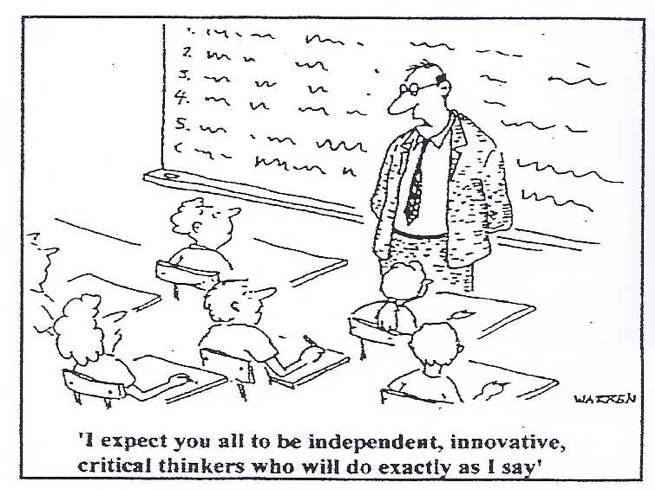
When I first assessed my class schedule and what classes I need to take in the next two years, I remember pausing to stare at this particular one. “What,” I wondered, “does democracy have to do with the classroom? I can understand in Social Studies, but this does not seem to have a direct application to what I have to teach.” Classes, at least as far as I can remember, seemed to consist of the teacher…and then the students. The teacher generally dominated the class while the students hurriedly took notes or otherwise proved subservient to the teacher. (Forgive me if I appear to be misremembering: a few years have passed since I attended high school).

I recall being taught the presidents in elementary school and receiving a ruler with each president in the order he worked. I also remember watching Animaniacs and learning how to memorize my presidents from that…a method that worked far better than anything the school taught. I vaguely recall class decisions on who would take the class pet home for the night (I wanted to but my parents reminded me Ariel the cat would enjoy it as a meal). However, I also remember that classes seldom took my viewpoint into account.

If democracy supposedly listens to everyone and takes multiple perspectives, my schooling experience stated otherwise. I wound up in remedial classes due to feeling poorly the day of assessments and even after I proved my worth in reading, they still held me back in math (despite possessing good math skills) and attempted to enroll me in remedial gym. My parents had to intercede. Surely, a democratic society would have enabled me to prove my merit and be able to advance forth on my negotiated terms. Or, perhaps, this still counts as a democracy, in that my parents served as my representatives?

I often complained of oppression in elementary school and middle school. Even though my parents repeatedly visited the principal’s office to complain about the abuse (at times physical—during one gym class boys threw basketballs at my head), nothing was done. Too often, my parents heard a variation of “boys will be boys”. Unless democratic representation means that everyone is heard, but not everyone matters, this fails to impress upon me schooling establishing democracy. However, it seems to state the point that our democracy pays more attention to the elite and to the privileged few than to others.

I begged my parents to have me homeschooled or, in lieu of that, transfer me to another school. They refused, my father stating that I needed the social interaction. My family did not function like a democracy either: I pleaded my case and my father, most often, ignored my suggestions and proceeded as he thought best. This, too, reflected the school and teachers I encountered.

The teachers I had who exercised democracy within the classroom seemed few. My English classes tried for group discussion and a few of them succeeded, but anything beyond Honors had the teacher dictating everything. I remember, on occasion, being able to shift the due date of a test or an assignment because it conflicted with another class. We took a vote on it and the teacher moved it back. This is as close to the idea of a democracy as I can think of right now.

Yes, we had school elections. We elected to rename our mascot once the Parsippany Redskins were deemed offensive…but the entire eighth grade class knew someone had rigged the results to mirror Montclair State’s then renamed Red Hawks. We had elections for class president and the like, as well as prom and homecoming people, but those were always popularity contests. Besides, despite all their promises, I cannot really remember those students functioning as more than figureheads, offering the pretense of democracy without fulfilling it.

Perhaps that explains my initial reluctance to deal with this subject matter. When it comes to democracy in school, I cannot say I have encountered a lot. I might be too cynical, but school to me has always consisted of the teacher issuing instructions and the students following them. There are few exceptions, though, judging by how much trouble Mr. Kyle got into when holding the trial of George W. Bush in class…the exception might prove the rule.


http://www.foxnews.com/story/2006/03/03/nj-high-schoolers-try-bush-for-war-crimes/ (Included because I seriously cannot believe this actually reached FOX News)


Tuesday, September 24, 2013

Ethnography and putting together past, present, and future

One often wonders how much of one’s perceptions are based upon immediate response and how much depend upon what one has encountered in the past. In the classroom, a teacher relies upon experience and usually, the more experience the teacher has as a teacher, the better he or she is. As someone who has yet to teach much more than Hebrew (I tutored at age fourteen), I carry my past self as well as my classmates’ past selves along with me to assess the situation. I suppose, in this respect, I find myself at a disadvantage. Using oneself as a stepping-stone to students in an area where I enjoy great proficiency may inadvertently blind me to my students’ faults.

One of the problems I faced when I was younger, refusing to read assigned readings or doing as little as possible, has fortunately changed as I entered college. Unfortunately, I believe this will transpire when I teach high school. Besides telling my past self (who is unfortunately not very good at listening) that reading schoolwork will enhance grades, I have yet to figure out how to drive this point home. A lot of students do not care about grades. When I was in my formative years, I performed as best as I could to coast by on Bs and Cs. As long as I did well, I gave the minimal amount of effort. After discussing the matter with one of my friends, I discovered she did the same. This will be a real obstacle to overcome when I become a teacher and cannot simply impress upon my students, or my past self, the importance of reading assigned texts.

Part of the problem, one that I struggle to recall in college and graduate school, involves being imprisoned in one building for eight hours. In Gatto’s article, he discusses how school is like a prison and was originally envisioned as a form of punishment, to beat people down and disrupt their thinking processes. Those who enter homeschooling do not have the rigid structures as those who enter public or private education, yet they appear educated all the same (as Gatto argues). However, the main component of schooling seems to be socialization…an area that my young self found difficulty with. People seem to forget that while the object of school is to get an education, one does not learn in a vacuum.

Once people realize that learning does not take place in a vacuum, they should also realize that people need to have a say in what goes on in the classroom. Students in particular need to feel like they had a voice—the classes I liked the best were the ones in which the teacher actively encouraged us to take a stand and debate among ourselves. My past self in high school was most engaged when I had to present material in front of the class and appear as realistic as possible (such as defending an argument). This might be a good method to carry into teaching—make the teaching have immediate relevance. Make the students feel part of a community, a community who cares and whose values make a whole. In my history class, I had to defend Hoover and ascertain whether he was responsible for the Great Depression. I worked in a group and another group played the prosecution. In the end, everyone had to vote on it. This, to me, consists of a democracy. Not only does it demonstrate a democracy at work, it helps students later put together the pieces and work with this in real life.

Even with these ideologies in mind, I suspect that not everything I want to put into play will occur the way I want it. Then again, it is like people say about battle: you can plan all you want, but once the battle starts, it all goes anyway. Be true to oneself and hope that the past selves can come together, form a coherent whole, and help the present and future self out as a student and teacher. That is all anyone can really do.


Sunday, September 8, 2013

Democracy

I wonder, beyond the requisite “doing well” goal that seems to match every class, how to best quantify what I want out of this course. Besides performing to the best of my ability, I want to be challenged. I want my viewpoints to be altered with new knowledge and I want to be able to take what I learn in this course to further classes and my classroom in the future. For a relatively abstract idea (democracy), I want it to become self-evident and for it to be cemented into my mind. Democracy seems uneven in the classroom and one of my goals is to be able to more readily observe it.

To that end, I would like to see democratic activities within the classroom. Since it occurs to me that I have difficulty, particularly in relation to college classes, relating democracy to the classroom, examples would be helpful. With the creation of groups, one can clearly see the power dynamic and how democracy should work. In a group where everyone does his or her part, the work progresses better than simply the sum of its parts. In classes where group work assigned has everyone participating to the best of his or her ability, things turn out wonderfully. I would like to see that happen again, where everyone pulls his or her own weight and turns an assignment into an art form.

Yet as I consider this, I also consider the reading due for this week. It seems as though the book mentioned the history of schools and democracy within without revealing all the evidence for why democracy is necessary. Yes, schools taught students to be patriotic in the past and people who worked to improve schools thought schools should be used to create better citizens. The questions linger, however: why? How? How does school transform students into better citizens? What activities lead this to happen? Why is it schools, among other venues, that culminate in better citizens as opposed to say, churches or community events? What is it about a class that better lends itself to democracy?

For the most part, it does not appear as though classrooms always facilitate independent thought. Teachers ‘teach’ to the test and evaluations are at a premium, with tension weighing heavily upon students and teachers to perform. In school, one does a teacher has instructed one to do. Yet in a democracy, teachers should listen to their students and accept feedback. How often does this really happen? Does democracy still exist within the classroom? If so, where?

(I open the floor for discussion).